Clothing
In the earliest periods the inhabitants of the former region had ONLY wool, the latter only had cotton, but at a very early time trade made both materials available everywhere. These textile fibers, wool from the highlands and cotton from the coast- especially the former- were practically state monopolies and were regularly given to the people. he wore woven or knitted textiles, and these were always worn whole, never cut or tailored were good and Comfortable; they were held together by large metal pins.
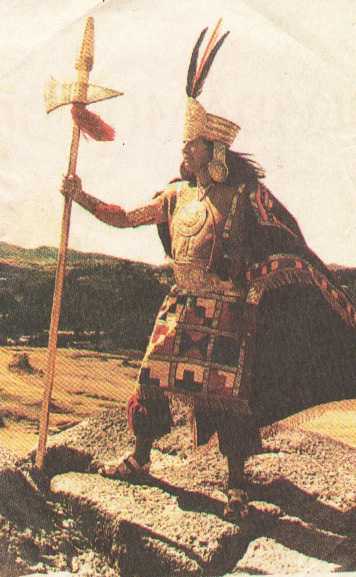
Inca Emperor
Sapa Inca wore each cloth for only once. then they were burned. So they need to supply lots of cloth for Sapa Inca. As you know "chosen women" were the ones who prepared clothiesfor Sapa Inca. So they had to remain busy. Only the Inca could wear a headdress with his special fringe of gold and feathers.
His coat was covered with jewels. Sapa Inca wore gold and jewelries on different parts of his body. He wore heavy gold shoulder pads and heavy gold bracelets and earrings. His earrings were so heavy that they pulled his earlobes down until they rested on his shoulder pads. he woreshoes that were made of leather and fur of animals that were very soft for him. He wore a royal shield and a royal badge. The shield on his chest was drawn with a picture of the sun god and the badge was made of hummingbird feathers, framed with gold.
Inca Nobility
Inca nobles wore rich costume, but a bit sober than Emperor. His dress was of the finest wool of the vicuna, richly dyed, and ornamented with a profusion of gold and precious stones. Nobles also wore the llautu, with a tasseled fringe. The birds from which these feathers were obtained were found in a desert country among the mountains. All people during that regime wore jewelry. Inca and Nobles ALWAYS wore golden jewelery.
Man
Man usually wore a sleeveless tunic, generally made of a broad piece of cloth doubled and sewn together along the edges, the bottom being left open, was also worn. A large cloak, worn over the shoulders with two corners tied in front, completed the man's body ,sometimes this passed under one arm to leave the latter free for activity.
Breech cloth, tunic, and cloak were all of cloth woven with colored ornamentation, the latter of course varying in quality according to the man's position. Inca sandals were of untanned llama hide, but sandals of other materials such as braided fiber are known archaeologically from some regions. Every man used a small bag in which he carried his coca leave, amulets, and other such small personal effects.
Hair styles varied greatly from tribe to tribe, but Inca men cut their hair, leaving it short in front, medium long behind.
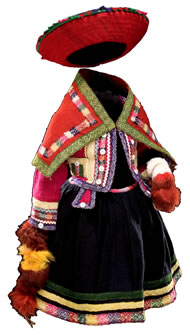
Woman
Woman wore a one-piece dress that combined skirt and blouse, reaching to the ankles and bound at the waist by a long, wide, woven, and ornamental sash. At the top, it reached to the neck, the upper edges fastened together over the shoulders by long pins and passing under the arms at the sides. The man's cloak was a large mantle, worn over the shoulders and fasted at the front with a large straight metal pin known astopo.
These pins of copper, silver, or gold, have large heads of various types, sometimes in the form of animal or human figures, but most commonly ending in a large, thin, circular, or semicircular disk, the sharp edges of which could be used as a knife. The women wore sandals and head bands similar to the ones men used. Usually they wore a large piece of folded cloth on the head. They did not cut their hair but parted it in the middle and wore it hanging down the back; it was cut, however, as a sign of mourning.
Mr. Norman and Classmates I'm going to show you some pictures about men and woman Incanclothes that were used before.